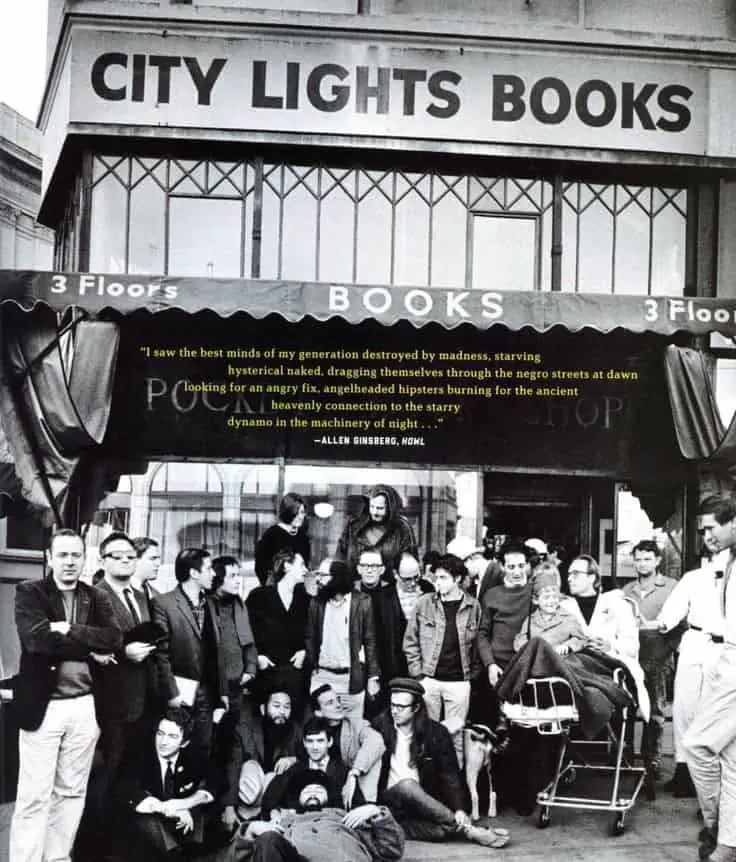
It did not always look like this, however, though now that seems quite difficult to believe. A city free of hippies? A town sans the divinely radical, the imperfectly socialist? Did such a city ever live and breath? If you can imagine it, yes it did. Before the hippies that puffed their psychedelic lifeblood into dear Francisco, there were the Beatniks. Their poetry, doped up and thick with socio-political imaginings, provided so much of the infrastructure San Francisco needed to become and remain a pillar for the movers, the shakers, the young dream makers. The king of all of them, in case no one ever told you, was Allen Ginsberg.
Born ninety-two years ago on June 3rd, 1926, the poet would come to sit at the right hand of contemporary American literature, and most certainly San Francisco literary culture, along with the likes of Jack Kerouac and Neal Cassidy—all of which struck quicksilver when properly aligned with the genius of City Lights Booksellers in North Beach. With his insightful, controversial poem “Howl,” released in 1956, the writer skewered American society and the inner workings of his own mind in one fell swoop, angering and inspiring and changing society along the way. The first prose of the work was written right in Nob Hill under the influence of peyote, and finished over the next two years as Ginsberg freed and untethered himself more and more, ultimately creating one of the most beloved, the most stripped, the most raw pieces of American literature. Pick any line, any stanza, and you’ll be forced to think in ways quite daunting. Ginsberg wrote of those “who wept at the romance of the streets with their pushcarts full of onions and bad music,/who sat in boxes breathing in the darkness under the bridge, and rose up to build harpsichords in their lofts…” He wrote of society and sexuality and doomed dreams and broken minds. The poem touches a million things, relevant then and most certainly relevant now. It’s the type of art that, each time you read it, you gain something quite different than the time before.
Without a doubt, the Beats redefined not only the existence of liberal artistic expression, but also rewrote the legality of it. Hence forward, San Francisco has looked different. Spoken differently. A precedence was set as to what kind of city it would be. And in many ways, it has not wavered.